Whether or not this is true is almost irrelevant.
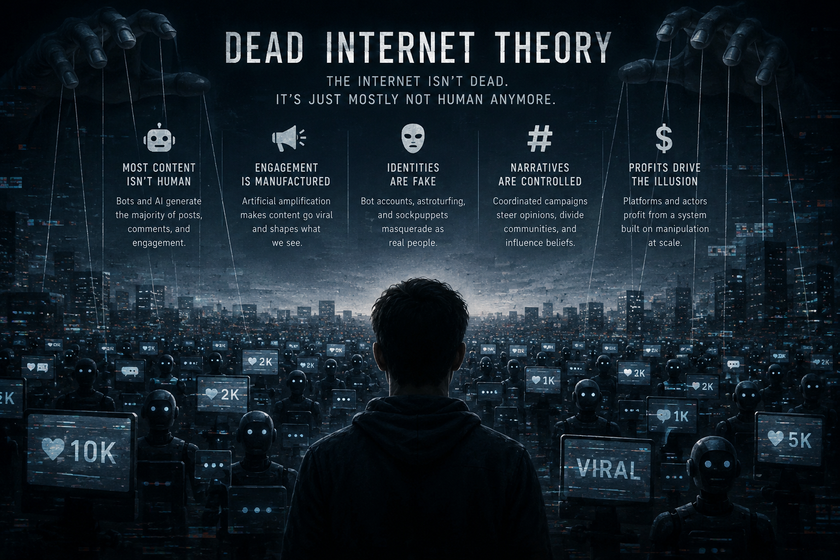
Whether it happens in 90 days or several years, there is a perfect storm that is leading to a frightening realization of the Dead Internet Theory - the notion that the activity behind the Internet we've all come to depend on is gravitating toward bots and algos talking to one another.
That perfect storm has a lot to do with easily-deployable AI agents, but the lack of a functioning FCC in the US is also a huge contributor. So is the proliferation of governments attempting to sway public opinion with bot campaigns. But let's not sail into tinfoil hat territory. We don't need to. Let's just look at that's doing to consumption habits.
Cohort Aware has grown up in an era of private communications - there has always been a group chat. Whether that happens on WhatsApp, Snapchat. Discord or even text messaging on their phones is largely irrelevant. What matters is that these are the places where connection can occur without the influence of bots.
Outside influences are not welcome. That includes targeted advertising. As soon as targeted ad opportunities come into play, the younger set is off to the next platform.
That is a huge problem for advertisers looking to engender brand loyalty in younger people.
Communications are growing more insular. That means more people advertisers will have trouble reaching with the usual suspects, even if YouTube continues to enjoy the popularity it has with Gen Z.
At this point, it makes sense to engage in a thought exercise. Think about what it looks like when young people are actively revolting against algorithmically-driven social media, bots, and the Dead Internet in general. What happens when consumption habits are a lot more insular than they are today? When media consumption consists largely of talking to friends in tightly-guarded communities that can collapse and be rebuilt in minutes if there's a need to move platforms?
When Cory Doctorow talks about enshittification, much of the reason platforms continue to make money even after they abuse the hell out of their user bases is the switching cost. Boomers and GenX have a tough time getting off of platforms like Facebook because they have hundreds or thousands of friends there, and the cost of switching platforms means having to convince those friends to switch along with them.
But for Cohort Aware, there isn't as much heavy lifting. It's easy to move a group of 20 friends talking on Snapchat to a private text or to WhatsApp for that matter.
If connection is happening in smaller groups on more insular platforms, that's a rather unique problem for advertisers.
Since the commercial explosion of the web in the mid-90s, we've thought of the Internet as something that naturally routes around issues. I think this is the GenZ version of that old axiom. If the signal-to-noise ratio is being ruined by bots, algorithms and non-human traffic, young people will simply route around it by shifting their activity to spaces they can control.